Participant Group: Disabled children and adults

Workshops via Create Live! Connect SEN students

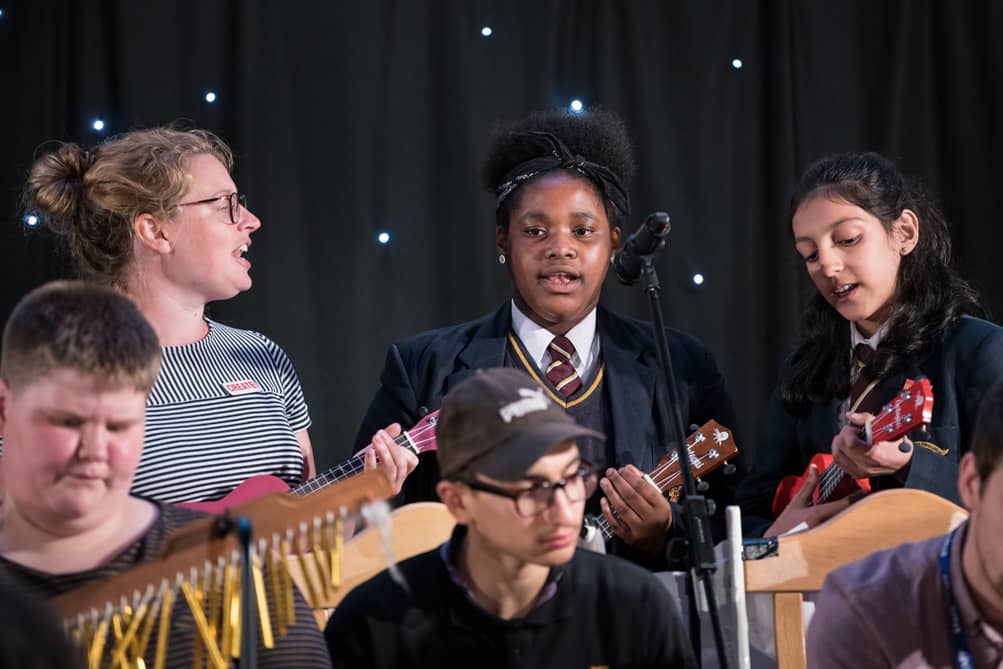
sen students enjoy the creative explorers workshop

Workshops via Create Live! Connect SEN Students

sen students enjoy the creative explorers workshop

The COVID-19 pandemic has caused huge disruption to the education system throughout the UK. Students are not only worried about staying up to date with the curriculum, they are also concerned about being isolated from their friends in the longer term, owing to social distancing rules and classroom bubbles.

Set against the wider backdrop of deteriorating mental health in children owing to the pandemic, we knew that it was critical for us to adapt our workshops to reach the most vulnerable students in schools.

Piloting a new Format

With this in mind, we ran our creative:explorers project with students with special education needs (SEN students) at John F Kennedy Special School in Newham during November and December 2020. With in classroom support from the staff, we delivered a series of visual art and music workshops via our online delivery mechanism, Create Live!.

“These workshops helped the students to develop increased communication skills by exploring new ways to interact with their peers.”

Zoe, staff member at John F Kennedy Special School

The workshops, which were led by our professional artist Chloe Cooper and musician Mike Poyser, used art and music to explore emotions through colours. They enabled the children to explore their creativity and self-expression, while building social skills, digital skills and self-esteem, enhancing their wellbeing.

creative explorers quote block

Our standard Create Live! format involves individual participants joining each workshop from their own space. For this project, however, three groups of SEN students joined from separate classrooms, in their bubbles, using Create Live! to connect safely and digitally. This was a first for Create, and it posed an interesting challenge.

Each room had its own computer screen and webcam, which allowed the students to see the workshop facilitators and the other classrooms. The staff at the school acted as intermediaries, supporting the children in their workshop tasks and muting or unmuting the microphone when needed.

“I structured the sessions so there were lots of little tasks to do, like jamming along to some drums, writing chants, brainstorming ideas, and so on,” explained Mike. “We gave the students space and time to be creative in their rooms with limited input from us at times and also spent time listening to each class’s ideas.”  

“IT CAN’T BE OVER-EMPHASISED HOW BIG A DIFFERENCE IT IS”

“Working in a classroom rather than on individual screens is a big difference and it can’t be over-emphasised how big a difference it is,” said Mike. “Running this session was a totally alien experience at first. Talking to classes from my house and being unable to get much instant feedback felt odd. But we all settled into ways of making it work. The support staff were absolutely brilliant, and we relied heavily on them to help implement our ideas.”

The possibility of seeing their friends while creating music and art together had a positive impact on the children.

“I particularly enjoyed watching the students working together during the music sessions and drawing their favourite things during the art workshops,” said staff member Zoe. “These workshops helped the students to develop increased communication skills by exploring new ways to interact with their peers. They also got the chance to gain greater knowledge of their feelings and how to express them, while developing the confidence to share their ideas. And those who are non-verbal could show their emotions in a much deeper way.”

Their joy was palpable on the sharing day which, owing to a new lockdown announcement in mid-December, unexpectedly became the final day and its biggest highlight. This session was like a mini party. The students danced to the songs they had created while holding their artwork up to the webcam for all to see. As one child enthused, “I enjoyed singing with my friends and sang on my own in front of the whole group.”

“The final sharing offered the participants a great opportunity to revisit what they’d worked on and bring it back to life – there was lots of dancing and smiling faces!” said our Project Manager, Hannah.

Thinking on our feet

Create Live

We are delighted with the success of this creative:explorers project and how the workshops enabled SEN students to connect with their friends, express themselves and feel joyful at such a difficult time.

The volatility and unpredictability of the pandemic has pushed us to think on our feet and change our approach at a moment’s notice, working closely with our partners to find solutions that work for them and – most importantly – our participants. It isn’t always easy, but we have been relishing this challenge!

Since the launch of Create Live! in April 2020, we have remained committed to finding new ways to run our workshops safely and effectively so we can continue to reach our participants when they need us the most. We have already run more than 620 workshops and are excited to see where Create Live! takes us next…

sen students enjoy the creative explorers workshop

Support this work

£
Select Payment Method
Personal Info

Credit Card Info
This is a secure SSL encrypted payment.
Billing Details

Donation Total: £25.00

Meet Jamie and Richard

creative connection 2018 meet jamie and richard

MEET JAMIE AND RICHARD

creative:connection is our award-winning programme breaking down barriers between young people from special and mainstream schools. In July 2018, pupils from The Queen Katherine School and Sandgate School in Cumbria collaborated on a sculpture project. Two Kendal students told us about their experiences taking part in the project.

“I didn’t know any of the Sandgate students before. I’ve learnt about what issues people can have.”

Richard

Jamie, who attends Sandgate School:

“We’ve been making fish and underwater animals. We’re making them because people waste plastic and then they drop it in the water and the fish swallow the plastic and die because they think it’s food. I learned that it’s important to put plastic in the bin instead of throwing it on the floor. I’ve learned loads from Jack [Create’s professional artist].

“I don’t do creative things much apart from on Tuesdays at school. I’ve enjoyed all of the project. I liked the spray-painting that we did, and making the jellyfish head using weaving and threading. It’s been good working with the Queen Katherine students. I go to The Queen Katherine School at lunch so I’ll see the sculpture there.”

creative connection 2018 meet jamie and richard

Richard, who attends The Queen Katherine School:

“I’ve had the most fun on the project. You can make good things out of plastic if you proper think about it, like we’ve been making a turtle. I liked putting the plastic together to make the sculptures. This is the first time I’ve done sculpture. I wasn’t expecting us to make something so big.

“Being creative makes your brain better because you have to think of different things. It’s useful because if you have to make a poster in a history or French lesson at school, or if you’re designing your bedroom, you’ve got good ideas to do it.

“It’s nice working in the group because you can get to know people more. I didn’t know any of the Sandgate students before. I’ve learnt about what issues people can have. If you do something that a Sandgate student has an issue with and you didn’t know, you wouldn’t do it again because you’d know it would proper get them and they would have to calm down. Once you know that they are really friendly. They’re not as shy now as they were on the first day, and they’ve got good talent.”

creative connection 2018

Names changed to protect anonymity

Create’s charity partnership with Deutsche Bank

deutsche bank partnership connect create
connect create deutsche bank wandsworth

CREATE’S PARTNERSHIP WITH DEUTSCHE BANK EMPOWERS YOUNG PEOPLE THROUGH CREATIVITY

In April 2017, we launched connect:create, a partnership with Deutsche Bank. Via the programme, we’ve been able to work with over 120 young people: pupils with autism in west London, and young carers in Birmingham, Lambeth, Merton and Wandsworth.

Deutsche Bank’s Head of Corporate Social Responsibility UK, Nicole Lovett, explained: “Through Born to Be, our youth engagement programme, we are committed to driving social mobility. The World Economic Forum predicts that by 2020 creativity will be the third most important skill in the jobs market. The connect:create programme plays a vital role in developing key skills, like creativity, so those most in need improve their life chances.”

The young people who’ve taken part in the programme have explored artforms from spoken word poetry to life-size self-portraits; and collaborated creatively to choreograph dances and write songs. For young people whose opportunities to express themselves, build confidence and make friends can be limited because of autism or caring responsibilities, the chance to learn a new skill and share creative ideas with peers can be truly empowering.

Thanks to Deutsche Bank, the young people who took part in connect:create have had access to the benefits of creativity through workshops run by our professional artists and we’re delighted that, after a fantastic first year, Deutsche Bank has renewed funding for connect:create for a further two years. We’re also delighted to have won two days ago Children & Young People Now Highly Commended Awards recognising our work with two areas that Deutsche Bank are supporting: young carers and young people with disabilities.

deutsche bank partnership connect create

Adam (not his real name), 15, a young carer who took part in connect:create, told us about his experiences during our animation workshops: “During the animation project we started from scratch, got materials together, and worked together to make an animation. Animation looks easy but it takes time, you can’t just do it first time round, you have to keep trying. When we’d finished the animation, I felt surprised that just from putting some materials on paper you can make a film. You work as a group and make what you want to make. At times I can be moody and only join in when I want to but this project has shown me that I should join in all the time.”

Andrew Nowak is Deputy Head of Queensmill School in west London, a specialist school for children and young people diagnosed with autism which partnered with us during connect:create. Like Nicole, Andrew says that creativity is essential for the development of key skills:

“The work Create is doing today is valuable because we’re talking about young people who have significant challenges in terms of imagination, creative thought and working with others. Projects where we’re challenging the young people to work creatively, to work with their peers, to come up with new ideas outside their areas of interest, play a significant role in their education. I don’t think you can underestimate how difficult the young people here find it at times to work collaboratively, to work creatively, so any project where we’ve got people who want to provide support in developing those skills is of vital importance.

“One thing we do know about autism is that lots of skills that are perhaps inherent in other people we have to teach, so by doing projects like this we are teaching the young people to be creative, to use their imagination. The hope is when they come up against challenge they can reflect on those experiences and think about how they can succeed. This project will serve as a reference point for the young people, so at times when we are challenging them to think creatively or when we are asking them to work together, we can say: ‘think back to that time when you did that Create project, think about the skills you used, how did you approach it?’

“The project is also getting them to think about things they wouldn’t otherwise think about. With young people with additional needs you can fall into a trap of having quite a narrow curriculum and being really focussed on core skills, but they need to learn about everything and understand the world.”

We also won the FSI Small Charity Big Impact award earlier in the year, one of the prizes for which was a film, which we chose to focus on our Deutsche Bank project with Queensmill School. You can watch this here, and below.

This article is from 2017.

Biggest ever creative:connection project celebrates One Love Manchester

creative connection Manchester 2017

BIGGEST EVER CREATIVE:CONNECTION PROJECT CELEBRATES ONE LOVE MANCHESTER

In July 2017, in Manchester and Salford, Create ran its biggest ever creative:connection project.

Four of our professional musicians worked with 56 disabled and non-disabled pupils from four schools to write original songs and music. The project culminated on Friday 14 July, when the young people gave two vibrant lunchtime performances of their seven pieces to an audience of 800+ people at intu Trafford Centre.

The schools involved were Chatsworth High School (for pupils with severe, profound and multiple learning difficulties and autism), Grange School (which provides education for the “Autism Community”), Loreto School (a mainstream secondary school), and New Park High School (for pupils with special educational needs or social, emotional or mental health difficulties).

creative connection Manchester 2017
Create 2017 performance on the Orient Stage – Trafford Centre

Themed around “Manchester”, our professional musicians Emily Allen, Matthew Dunn, Mike Poyser and Bethan Roberts drew song and music ideas from the young people who created and rehearsed their new musical pieces with support from amazing volunteers from project funder intu.

Below are the lyrics to One Love Manchester, which was written and performed collaboratively by pupils from all four schools, the chorus also being sung in sign language. Pupils from Chatsworth High School prepared a slideshow of iconic images from Manchester, which were projected on a big screen during the performance.

Chorus (Written by all participants)
Even though the skies are grey
Music lifts the clouds away
We’re singing all together
One Love Manchester

Verse 1 (Written by New Park High School & Chatsworth High School)
We believe, let’s unite
Stand together, let’s not fight
Although people try to break us
Peace and unity is a must
Shoulder to shoulder, hand in hand
Together in Manchester, we must stand
I’m not city or united
I’m a Manchester fan, our kid!

Verse 2 (Written by New Park High School & Chatsworth High School)
Robots dancing at the MOSI
Salford Quays, a sight to see
If your life gets too boring
Hit the museum of Alan Turing
One of my favourite things to eat
Eccles cakes in Albert Square
Let’s all join in with the beat
Football, cricket, we’ll see you there

Verse 3 (Written by Grange School & Loreto School)
Vibrant, inspiring, creative energy
Strong sense of community and solidarity
Our bond is unbreakable in this city
We’re destined to be

Manchester and me!

Verse 4 (Written by Grange School & Loreto School)
Cup of tea and Bourbon Cream
Everyone knows that is my dream
Sharing our Tombola ices
Sweet and salty, all the spices
Curry Mile and China Town
This is how we like to get down

creative connection Manchester 2017
Create 2017 performance on the Orient Stage – Trafford Centre

creative:connection is designed to tackle disability prejudice through collaborative creativity. In a survey carried out by Scope and Mumsnet, four in 10 parents of children with disabilities reported that their child ‘rarely’ or ‘never’ has the opportunity to socialise with children without disabilities. Scope also found that two-thirds of the British public feel uncomfortable when talking to disabled people and that disabled people themselves think more interactions between disabled and non-disabled children would bring about improved attitudes towards disabled people. We designed creative:connection to encourage the development of these positive attitudes among children and young people through the experience of collaborative expression.

Since 2013 we have run creative:connection across England, from Cumbria to Kent. The programme has worked with 954 participants, 97% of them saying they had enjoyed the project and working with our artists; 91% that it had developed their creativity and 89% that it developed their teamwork. In 2016/17, 100% of our community partner staff rated creative:connection “successful overall”.

I was lucky enough to be at the intu Trafford Centre performance and it was brilliant – not only could you see how much fun the young people were having but how much they’d bonded through the song writing and rehearsal process. New friendships were formed and a wonderful shared understanding developed between students of different abilities. They were creative and collaborative and the performance was inspirational, showing the power of working together towards a shared goal and passion. We’re so proud to have been part of this wonderful experience and thank intu Properties plc for making the project possible.

We hope you enjoy these amazing photos from the performance, © intu Trafford Centre and Nick Harrison.

By Nicky Goulder, Founding Chief Executive

Create shortlisted for 2017 Charity Awards

charity times shortlist
creative connection 2017

CREATE SHORTLISTED FOR 2017 CHARITY AWARDS

Every week at Create is an exciting mix of delivering current projects and working with community partners, participants and our professional artists to plan projects for the future. But this week was particularly exciting as we found out our creative:connection programme has been shortlisted for the Charity Awards’ prestigious Arts, Culture and Heritage Award.

The Charity Awards is the charity sector’s longest-running, biggest and best-known awards ceremony. Charities are judged by an independent panel of charity leaders as having demonstrated outstanding best practice which other organisations can learn from across 10 categories. The category winners, plus the recipients of the Overall Award for Excellence and the Daniel Phelan Award for Outstanding Achievement, will be announced at a black tie dinner on 8 June, held in the grounds of the Tower of London.

Julian Chislett, Chief Executive of Civil Society Media, which organises the Charity Awards, congratulated all the shortlisted charities on making the highly-coveted shortlist: “The standard of entries this year was incredible, and the charities we shortlist remain a constant inspiration to all of us. Our rigorous judging process singles out those charities with the most innovative ideas and the most inspirational approaches to delivering maximum impact.”

charity times shortlist

Our creative:connection programme brings school pupils with and without disabilities together to make collaborative art. Working with our professional artists, young people across England, from Cumbria to Kent, have made visual art, music, film and more whilst building shared understanding and developing confidence and communication skills.

This is the fourth time Create has been shortlisted for a prestigious award in the last 12 months. In November we won the Children & Young People Now “Arts and Culture Award” and earlier in 2016 we were shortlisted for both The Third Sector and Charity Times Charity of the Year awards.

The outcomes of our projects for the participants are the greatest reward we can receive for our work. But winning and being shortlisted for these awards is fantastic recognition of the hard-work and success of our committed team of artists, staff, community partners and the funders who make our work possible, and confirms Create’s position as the UK’s leading charity for empowering lives through the creative arts.

Nicky Goulder, Founding Chief Executive

Interview: Create artist Sheridan Quigley

creative connection 2016

INTERVIEW: CREATE ARTIST SHERIDAN QUIGLEY

Our visual artist Sheridan Quigley recently led two of our creative:connection projects, funded through our new partnership with Prudential plc. These brought together disabled and non-disabled students from Livity and Dunraven schools in Lambeth, and from Haymerle and John Donne schools in Southwark. Here she tells us about the work they created. (This article is from 2016.)

creative connection 2016

“Within creative projects, people bring a wide array of skills and interests that they have gained from all sorts of experiences in their lives to date, regardless of their particular circumstances. It’s not about having to produce work that can be graded or formalised but about expressing themselves, their imaginations and their emotional responses. Everyone has something to say, everyone has a unique perspective, all of which deserve to be heard and deserve respect. Consequently, collaborative arts are very democratic. What they require of the participant is a willingness to contribute as whole-heartedly as possible, without fear. A fully supportive environment, like creative:connection, makes this possible.

creative:connection uses collaborative art to bring together pupils from an SEN and a mainstream school. Working on the projects, you can see how beneficial it is to spend time with people who have different skills and life experiences. The pupils become accepting, respectful and patient, learning to work at each other’s pace and appreciate the different ways of doing things. It’s important to learn at a young age to be adaptable in the way you communicate depending on who you are with.

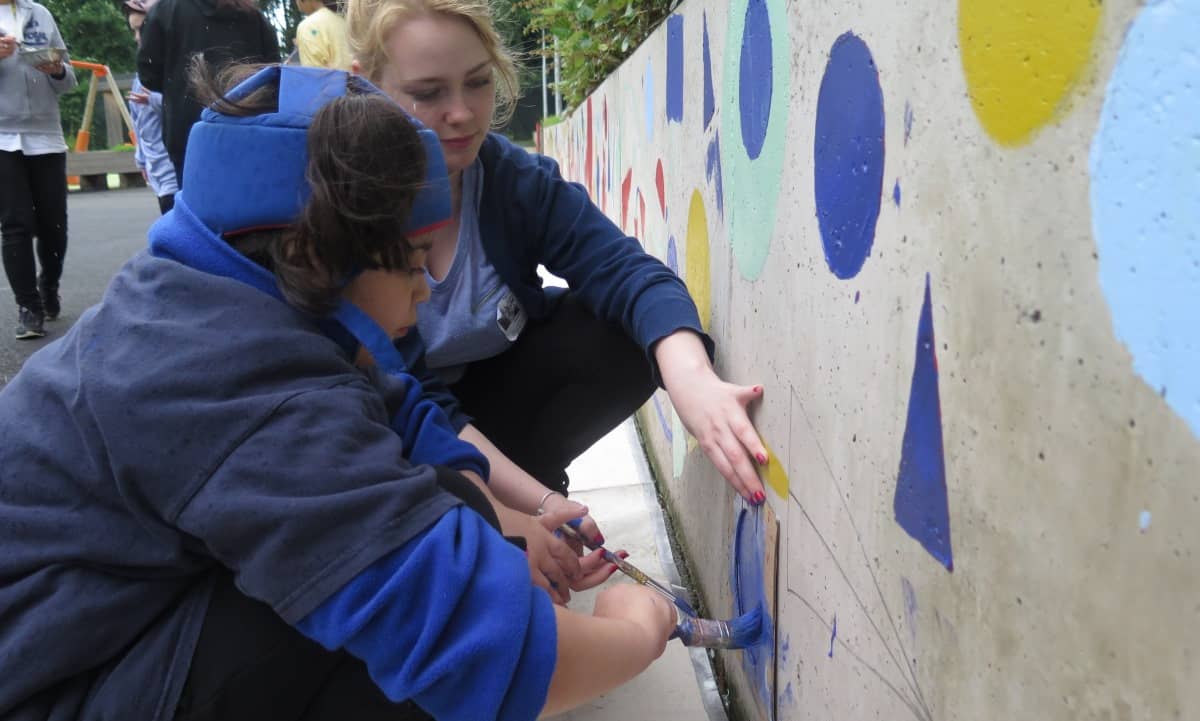
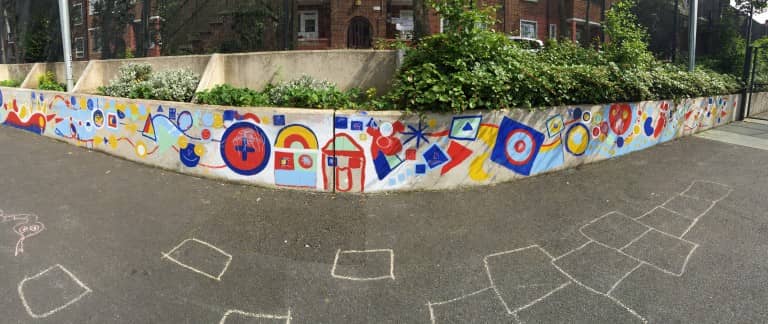
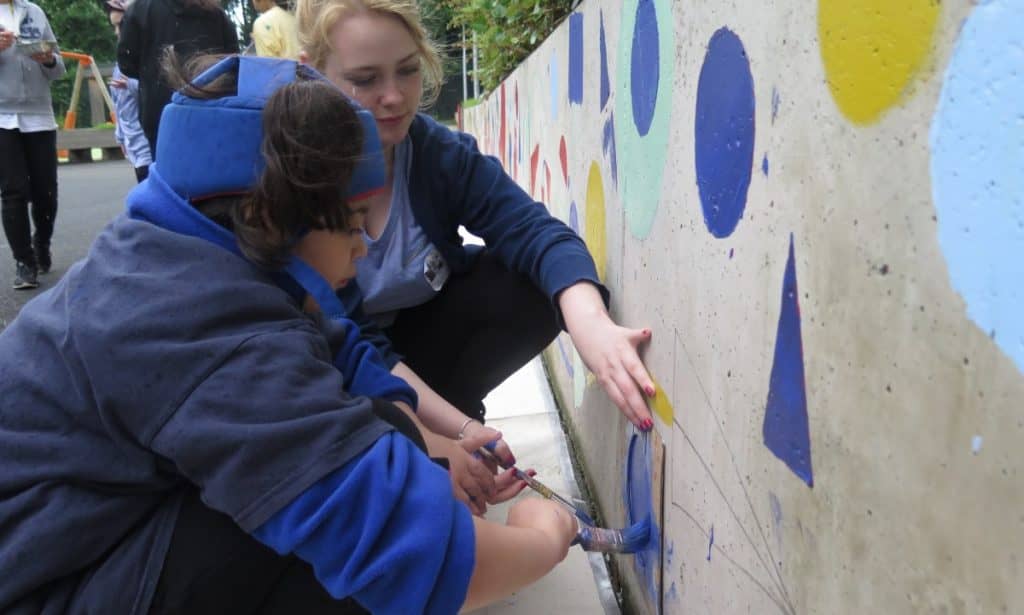
“In Lambeth we created a 30 metre mural for the playground wall of the Livity School. The idea was to produce a piece which, as well as being fun to look at, could act as a learning reinforcement for the pupils. Children at Livity School have severe learning difficulties, PMLD, ASD and complex medical needs, so the mural was based around the shapes which can most readily be identified, drawn and named by the pupils, namely circles, squares and triangles. Similarly, the colour palette of the mural focused mainly on primary colours: red and yellow being a particularly important colour combination for children with vision impairment. The intention is for the Livity pupils to further their enjoyment of the mural by drawing into it with chalk, engaging with the existing shapes and adding their own embellishments.

“Throughout the project the Dunraven students, who were older than the Livity pupils, took care to focus in on the individual personalities and needs of the young people they were working with, winning their trust and affection. Because the mural was in the playground, its development was visible to the whole school community. On the last day, we had members of staff across the school coming over and telling us how much their own pupils were enjoying the gradual emergence of the mural and looking forward to adding their own contributions.

creative connection 2016

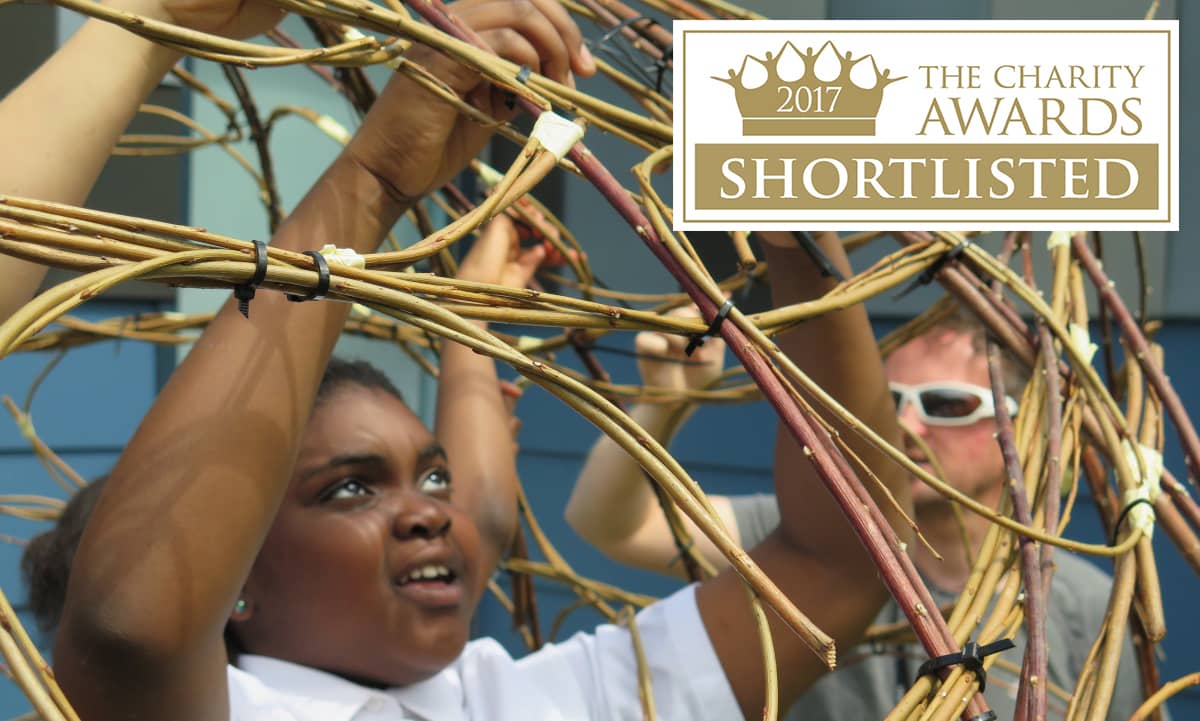
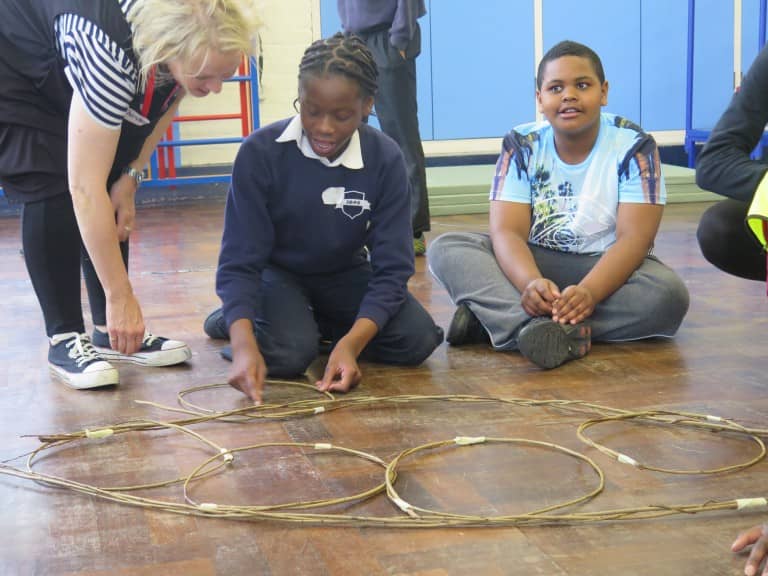
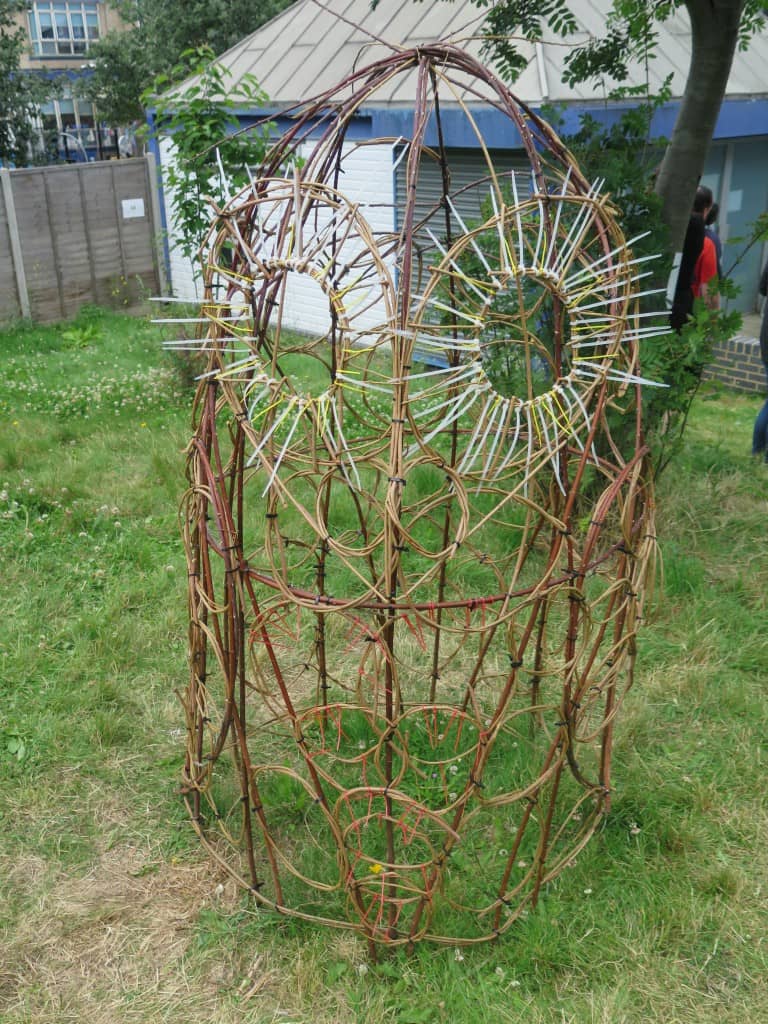
“Haymerle School, a school supporting children with a diagnosis of autistic spectrum disorders and social communication difficulties, has a meadow area for pupils to play in. Working collaboratively with pupils from Haymerle and John Donne schools, we built a series of willow structures in the meadow that could act as a focus point of calm and contemplation. We built two enclosed domes, which the pupils really enjoy sitting in, as well as a large owl and pussycat, inspired by the Edward Lear poem (which will provide material for future learning at the school). We also built a crawl tunnel, which is useful for helping to develop physical coordination.

“Working with willow involves a repetitive process of bending, twisting and securing. This is ideal for the age-group of the participants because they rapidly develop a skill that they can take personal responsibility for and then use it to contribute immediately to a collaborative building exercise. Throughout the project, the participants helped each other with all aspects of the build. Two groups of Haymerle pupils worked on the entire project, while the pupils from John Donne changed with every session. Consequently the Haymerle participants built up their understanding of the construction process and explained and demonstrated the techniques to the new groups of John Donne pupils. They found this exciting and empowering.

“We staged a full-blown ceremony to celebrate the completion of the willow structures, with a musical parade by many of the participants round and round the new sculptures, culminating in an ice-cream picnic inside the domes.

creative connection 2016

“On both projects there was a great sense of achievement and completion – in particular, amazement at the scale of what we made together. For me it reinforced the knowledge that every school is unique, every class in every school is unique, and every individual is unique. Although I have an overarching objective in mind at the planning stage of a project, the plan has to have plenty of space for the multiple imaginative inputs of the participants. I have to be prepared to go with the flow, adapting my approach as the moment requires, to respond effectively to the needs of the group and all its individuals. Consequently, every project is a collaborative learning experience – we’re all in it together!”

creative:connection in Southwark and Lambeth were funded by Prudential plc. Create has been running creative:connection since 2013, delivering 270 hours of creative arts workshops with 243 participants. In total, Create has worked with 8,245 participants with disabilities or SEN since it was founded in 2003.

This article is from 2016.

Kent sculptures communicate friendship, education and respect

Bradfields academy
Bradfields academy

KENT SCULPTURES COMMUNICATE FRIENDSHIP, EDUCATION AND RESPECT

Since 2008, we’ve worked with students at Bradfields Academy in Kent on a wide range of creative arts projects including drama, photography and music.

During each project, the students – who all have complex learning disabilities – have produced imaginative work, and they certainly didn’t disappoint in our sculpture workshops this July. (This article is from 2015.) Working in small groups, and under the guidance of our professional artist Daniel Wallis, the young people began by drawing their silhouettes onto a large piece of paper, which they then cut out and used to build bodies from tights filled with scrunched-up balls of paper.

After scouting the school grounds, deciding on a pose for their statue and choosing an area in which their artwork would be installed, they used wire to provide structure and shrink wrap to hold their sculptures together. They then decorated their figures with coloured shapes and clothes.

Bradfields academy

Each of the four characters represents a value that the young people wanted to express. The figure reading the books represents education and learning, the figures on the bench communicate friendship and community, and the figure picking the flower represents respect for nature. When the statues were complete, the students’ friends and teachers were invited to come and see their work in an “unveiling” ceremony. They took great pride in presenting the artwork they created which will remain on permanent display.

Max, one of the students who took part, told us how much he had enjoyed the new experience: “It has been really good to have a professional artist come in and teach us new skills. It feels like we’re learning something extra, something from outside school. I’ve never had the chance to do something like this before. And I definitely feel a lot closer to the other people that took part in the workshops. I would jump at the chance to do something like this again; I would love it if we could make some more sculptures! I would actually like to be an artist when I get older, maybe sell my art or give it to museums, so these workshops have given me a push in the right direction.”

We look forward to returning to Bradfields and inspiring more young people like Max. We wish him luck with his artistic ambitions – good luck!

Pianist Derek Paravicini at creative:space

Derek Paravicini at creative:space

PIANIST DEREK PARAVICINI AT CREATIVE:SPACE

Pianist Derek Paravicini (who is blind and has severe learning difficulties) and his music teacher Kelly Smith have been regulars at our creative:space events for disabled children & their families since their inception. Here they talk about what they enjoy the most.

Derek: “I enjoy playing my music on the piano for Create. The bands that play with me are always good. We play instruments together with the children – I especially like the egg shakers! My favourite part is when I take requests from the audience – I never know what music they are going to ask me to play! My favourite request was for the Bare Necessities and everyone was really singing along, it felt good. The concerts help children and their families to enjoy great music!”

Kelly: “I really enjoy coming to support Derek at the creative:space events. The atmosphere is always so friendly and welcoming and there is a real sense of togetherness that the music provides. The way in which the concerts are presented include everyone who wants to be included, and I think the children get a lot out of being so close to the musicians and being involved with the music making. My favourite part is always when the children take turns at ‘conducting’ an instrument. The look on their faces when they realise they are in control of the sound is always a joy! The concerts make live, top standard music accessible to people who might otherwise find it difficult to go to mainstream concerts, and that is a valuable and most worthy thing to be a part of.”

This piece is from 2014.

Meet Chandni

Meet Chandni
Meet Chandni

MEET CHANDNI

During spring 2014, we collaborated for the first time with Sense, the national charity that works with and supports people of all ages who are deafblind or have associated disabilities.

A group of deafblind children and other family members took part in our creative:connection project, working under the guidance of two of our professional musicians. Using a variety of instruments – and iPads – designed to stimulate a range of senses including sound, touch and sight, they experienced sound and vibrations through playing the instruments themselves and worked collaboratively to create soundscapes and melodies.

Chandni wears a cochlear implant on her left ear. She is partially sighted and experiences pain when there are bright lights. She cannot see people very far away, so relies on her cochlear implant. She can walk by herself, and can climb stairs with a rail. When it is windy, she feels wobbly but can walk well indoors. To speak, she needs to see faces and lip-reads to help her. This is her experience of creative:connection.

“This is the first music project I have done outside school. At school, we have music day, where we learn about instruments. For example, once we did Hawaii, and played ukuleles and did dancing. I loved learning how to play New World instruments with Create because those instruments are basically not from England. I liked the Cahon best.

“Playing with the instruments in general and performing were my favourite parts of the workshops! And the Bollywood dancing. The others participants liked my ideas, I think, because they always agreed with them. They always listened when I was giving ideas. This made me feel happy because at school, normally we don’t listen to each other as much. We only agree on the same things sometimes.

“I love music because it makes me relax. Music is good for you when you’re deaf because you’re not being stressed on what you’re not hearing. I enjoyed singing songs and putting them together. The workshops made me feel a bit more confident – showing people what I can do. The workshops have given me something to talk about at school, I’m not at home just sitting on my Mac all the time – I have got something to do. They’ve also taught me to be more considerate: I think I should let others speak first because I’m always speaking first. I made good friends, friends with people who have the same problems as me, similar.”

Name changed to protect anonymity.

This story is from 2014.

Meet Matt & Sam

Matt with his craft-loving daughter

MEET MATT & SAM

creative:space, our interactive music event for disabled children and their families, gives them the opportunity to hear live music, dance and do craft activities in an informal, relaxed and friendly environment that has been carefully tailored to their needs.

Here Matt Pearce, who has been bringing his son Sam to the event at The Stables in Milton Keynes since last year, talks about what it has come to mean to him and his family.

“Sam has learning difficulties and sensory processing disorder. He is not able to stay still or concentrate for more than a few minutes, which makes it difficult to take him to public music events. We do go out with him to other events at The Stables as well as autism friendly cinema showings.

“We are always very excited about coming to creative:space. After having been to many of them, Sam now recognises the route and knows that we are coming to a creative:space event at a certain point on our journey. The event provides a safe place for the entire family to enjoy something together, where everyone understands how Sam behaves. There is no need to worry about offending anyone or having to keep quiet or remain in your seat. It is very flexible and tailor-made to the needs of our family.

“At home we use music and songs to teach Sam; most of the words he learns come from the songs he likes. We are also trying to make sure that he interacts with people other than friends and family. creative:space helps us to do that. We noticed that due to the creative:space events, he has been able to speak and his communication has improved. Before coming to our first event, he did not speak at all. We have now also started to teach him how to make collage pictures. We loved your masks. Sam always enjoyed the event but he is a lot more responsive to what is going on now.

“My daughter really enjoys coming as well. She says that she loves all the craft activities and conducting the band. The events are a really nice way for our family to enjoy an afternoon out together.”

This story is from 2013.